I was walking up to my 50 gallon fish tank to feed my fish, as usual, when my socks get soaked by a big puddle of water on the floor. At first I blame it on my one year old toddler who is always spilling her water bottle all over the floor. I quickly wipe it up. But then I look up and see water leaking out of the bottom of my fish tank. Oh no.
I use a paper towel to soak up all the water, desperately praying that it was just leftover water spilling from the water change I did two days ago.
Ten minutes later, water continues to slowly but steadily leak out of my tank. My fiance says right away, "You better empty the whole thing, tear it down before it the crack gets bigger and damages our property." I have a mini panic attack. Tear down my pride and joy? A fixer upper I've poured almost $2000 into? No!
But reality was staring me in the face. I had no choice.
So I turned to Google. Explanations on how to reseal tanks were complicated and unfeasible. I didn't have time to do all that with a toddler to look after. I started going on Craigslist, desperately looking for another 50 gallon or larger tank to buy as a replacement. After sending a handful of emails, I went back on Google.
Meanwhile, in the background, my fiance's voice continues to nag, "What are you waiting for? Just empty the tank already! Move the fish and plants and stuff into your small spare tank."
I retort with great frustration, "Just give me some time to think about it!"
"Think about what?" He says, "It's leaking. You need to fix it or get a new one!"
So I hook up my Aqueon water changer hose and start draining away. I take out my spare 20 gallon tank (used as a plant terrarium) and start wiping it down, all the while silently mourning the loss of such a beautiful tank. I have spent 8 months getting it to the way it looks now...only to tear it down? And don't even get me started on how long it would take to catch all of my shrimp and fish in there (over 50!)
After changing out 50% of the water, I remove the hose. Ok, one last check on Google to see if there are ANY alternatives. One last check before I destroy my aquascape.
I visit a fish forum website and a genius on there was answering a question about leaking aquariums. He said in the past his tank had an unexpected leak. So he emptied it and tore everything down to check out the problem. Yet there was no crack or rupture in the silicone sealant. So he filled it up again and the tank started to leak from the bottom again. Long story short, he discovered that his filter was actually overflowing, causing water to drip from the back of the tank to the front.
OF COURSE!
I had noticed that after draining 50% of the water and unplugging my hang-on-back filters, the "leak" stopped for 15 minutes. Could it be??
I checked the back of the tank and lo and behold, there was a puddle of water right under my Fluval C3 filter!
So I refilled my tank and cleaned out my filter media. Plugged everything back in and it's been half hour now and NO LEAK! WOOHOO!
Problem solved.
Thanks Google for saving my butt.
Thank you inner intuition for staying calm and not listening to the advice of my fiance.
Imagine if I had torn it all down only to realize it was just the filter overflowing...
So just thought I'd share this funny story with you guys.
If you have a strange leak, make sure it's not your filter!! And don't keep the water level too high that causes the filter to overflow more easily.
Take care readers!
Chesmok
Showing posts with label water change. Show all posts
Showing posts with label water change. Show all posts
Tuesday, April 7, 2015

Wednesday, February 11, 2015
Aqueon Aquarium Water Changer 25-Foot (Review)
Tired of practically breaking your back carrying buckets of water back and forth from your aquarium to the sink?
Sick of mopping up dirty, spilled water after every water change?
Exhausted from spending 35-40 minutes changing out a measly 20 gallons of water from your 75 gallon tank?
(You get my drift...)
If you own a fish tank bigger than 20 gallons, there is no reason why you should not be spending a good $50 CAD and buying yourself an Aqueon Aquarium Water Changer. And if you own a tank larger than 45 gallons, and you haven't already gotten this device, you must be crazy.
Here's the Amazon.ca link:
http://www.amazon.ca/Aqueon-6089-Aquarium-Changer-25-Foot/dp/B000YAJKL6/ref=sr_1_1?s=pet-supplies&ie=UTF8&qid=1423693614&sr=1-1&keywords=aqueon+water+changer


Sick of mopping up dirty, spilled water after every water change?
Exhausted from spending 35-40 minutes changing out a measly 20 gallons of water from your 75 gallon tank?
(You get my drift...)
If you own a fish tank bigger than 20 gallons, there is no reason why you should not be spending a good $50 CAD and buying yourself an Aqueon Aquarium Water Changer. And if you own a tank larger than 45 gallons, and you haven't already gotten this device, you must be crazy.
Here's the Amazon.ca link:
http://www.amazon.ca/Aqueon-6089-Aquarium-Changer-25-Foot/dp/B000YAJKL6/ref=sr_1_1?s=pet-supplies&ie=UTF8&qid=1423693614&sr=1-1&keywords=aqueon+water+changer

I was skeptical at first too. I'd heard about these hose-like aquarium water changers for a long time, but it seemed expensive and not that useful in my mind. It was finally my fiance who convinced me to buy this. (Thank you!) I was grudgy about spending even more money on yet another water-changing device. After all, I'd already purchased 3 different gravel vacuums and a bunch of buckets.
But after a gruelling day of doing a 60% water change (I was tearing down the cichlid setup and doing a freshwater aquascape) on my 50 gallon and practically flooding my living room floor, I decided to go on Amazon and buy the damned thing.
It arrived in about a week (Thanks Amazon!) and the shipping was free (Thanks Amazon!)
My immediate grievance: the packaging in the ad looked like a simple plastic bag. What I actually received was THE TOUGHEST hard plastic blister packaging I have ever encountered in my life. It was as if they were trying their very best to prevent customers from EVER opening the packaging.
 |
| Toughest packaging I have ever encountered in my life |
It literally took me 1.5 hours just to open the f***ing thing. I had to use: heavy duty scissors, a can opener, and a butcher knife as well as my bare hands. The cut open shards of plastic would scratch my arms...
When I finally opened it, I took everything out. Very sturdy tubing. Good adaptors. Everything looked well made and good quality. I removed the faucet adaptor and tried to hook it up to my kitchen sink faucet (the only one that's closest to my fish tanks). No luck for 35 minutes.
I watched a Youtube video about it. Still no luck. Frustrated and nearly in tears, I tucked away the stupid piece of $hit and decided I was going to return it. Never again, I vowed. Never again.
(To be fair, the packaging comes with 3 or 4 different sized adaptors so it fits most sinks. Mine was just...unique...I suspect)
But I got carried away and never got around returning the thing and it just sat in my closet gathering dust for almost 3 weeks. By then I figured, I could try and buy another adaptor and if that failed, I could resell the water changer.
So I visited my local home hardware store (Canadian Tire as it were) and lo and behold, they carried a "Faucet to Hose Standard Adaptor for all N.American faucets". I bought it for $8. It was stainless steel.
I tried for 15 minutes to put this new adaptor on my faucet until I realized there was an aerator covering the top. That had to come off. (If you don't know what an aerator is, it's a covering for the faucet that looks like a small screen) Once that came off, I finally figured out that I had to match the threads and screw in the adaptor COUNTER CLOCKWISE. That's the key. COUNTER CLOCKWISE or it won't go in people!
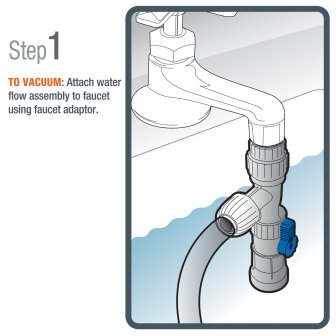
After I fit in the stainless steel adaptor, I hooked up the Aqueon plastic adaptor to it and the water flow assembly (the long bit with an open end and the blue switch) followed. I pushed one end of the tubing into the water flow assembly and twisted it tight. (See photo 1) Then I attached the other end of the tube to the gravel vacuum end (near the other blue switch). The plastic was very rigid so I had to blast it under hot water to soften it up a bit first.
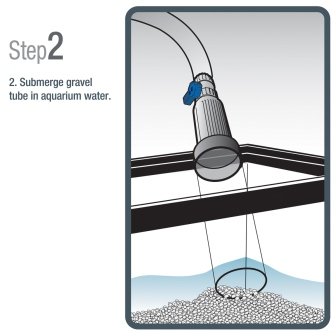
Next, I submerged the gravel vacuum end into my aquarium.
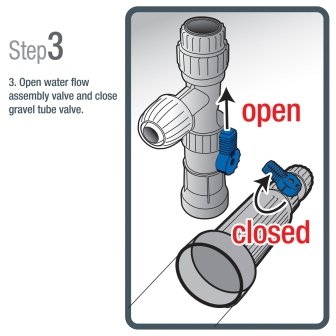
Step 3 here is important. Flip the blue switch attached to the faucet UP (this opens up the water flow assembly so tap water and aquarium water can come out of the base) and flip the blue switch on the gravel vacuum bit to the RIGHT (optional at this point).
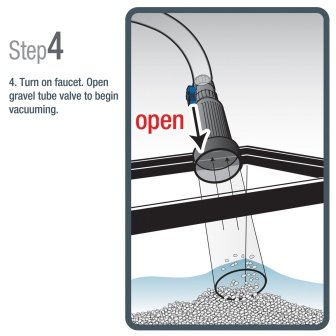
Step 4. Turn on the faucet. Water should be gushing out of the bottom of the water flow assembly. Next, with the other end of the water changer fully submerged inside the aquarium, flip the blue switch on the side UP (if you closed it earlier). It should be parallel to the suction tube. You should see water slowly rising and going into the tube, into the hose and out through the sink.
Note: if it's a small water change (5-10%) keep the faucet on. However, if you want to save water, especially if it's a bigger water change (10% or more), once the suction is fully started (you see dirty aquarium water exiting through the faucet adaptor) you can turn off the faucet. Water will continue to leave your aquarium due to sheer physics.
If you don't understand how to use regular gravel vacuums, see my previous post about How to Use a Gravel Vacuum.
Gently, just barely touching the gravel or substrate of your tank, suck up bits of rotting plants, leftover food and debris. DO NOT shove it deep into the substrate as this will release harmful nasties that were never meant to resurface.
Remember to cover areas under rocks and driftwood (where debris tends to build up unseen)
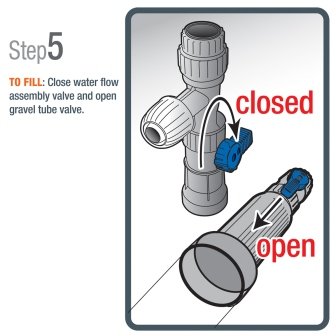
Step 5. Once you have finished vacuuming and changed enough water, leave the suction end inside the tank while you go to the sink and flip the blue switch on the water flow assembly to the RIGHT. This closes the bottom of the assembly.
NOTE: If you turned off the faucet to save water earlier, you must turn the water back on, check the temperature of the tap water FIRST before you flip the switch on the water flow assembly. This is to make sure that the tap water you refill the tank with is not too hot or cold.
NOTE: If you didn't turn off the faucet, you still need to check the tap water temperature before flipping the switch.
Once you flip the blue switch on the water flow assembly attached to the sink, tap water will flow through the plastic tubing, OUT through the gravel vacuum and into your tank. Make sure at this point that the gravel vacuum end's blue switch is OPEN (UP)
As you refill your aquarium, measure out enough water conditioner for the amount you changed out. (I.e. if you changed out 20 gallons of water, measure out enough to condition 20 gallons of tap water) Some advise you add enough conditioner to condition THE WHOLE TANK VOLUME but I find that wasteful and unnecessary. Take the amount of conditioner you measured out and pour a little in every corner of the tank to spread it out.
When you are done filling up the tank, go to the sink and turn the blue switch attached to the water assembly (this starts up the sucking again). Remove the gravel vacuum portion of of your tank and take it, along with the tubing, back to the sink. Hold up the gravel vacuum until all the leftover water is sucked out of the tubing. Detach the water flow assembly from the faucet.
All done!
Sounds like a nightmarish, complicated process but it's actually SUPER EASY and once you do it once, you'll never have to think twice about it again. Changing 20-25% water from my 50 gallon tank used to take 40-45 min and it was super messy. Now it takes about 10 minutes and I don't even need to do much. No more back pain. No more spills.
Partial water changes are critical to maintaining a happy, healthy aquarium!
If you have questions, comments, let me know!
Thanks for reading
Chesmok
PS: If you just want to do a simple water change and NOT vacuum the substrate, just tuck the gravel vacuum under the hood/cover/light of your aquarium and it will just change the water. Careful, sometimes small fish get sucked up by this powerful vacuum if you're not careful!
Subscribe to:
Posts (Atom)